Internet communication has changed how people express emotions, reactions, and everyday experiences. Shortened words and acronyms allow users to communicate quickly across social media platforms, messaging apps, online forums, and workplace tools. One acronym that appears frequently in digital conversations is FML.
For anyone searching for what does fml stand for, the answer depends slightly on context. In most online conversations, FML is a slang abbreviation that expresses frustration, disappointment, embarrassment, or disbelief about an unfortunate situation.
Although the phrase is informal and sometimes contains strong language, it has become a widely recognized part of internet culture. Understanding its meaning, history, appropriate usage, and limitations can help people communicate more effectively online.
This guide explains the FML acronym in detail, including its meaning in chat, workplace communication, entertainment, and modern digital culture.
What Does FML Stand For?
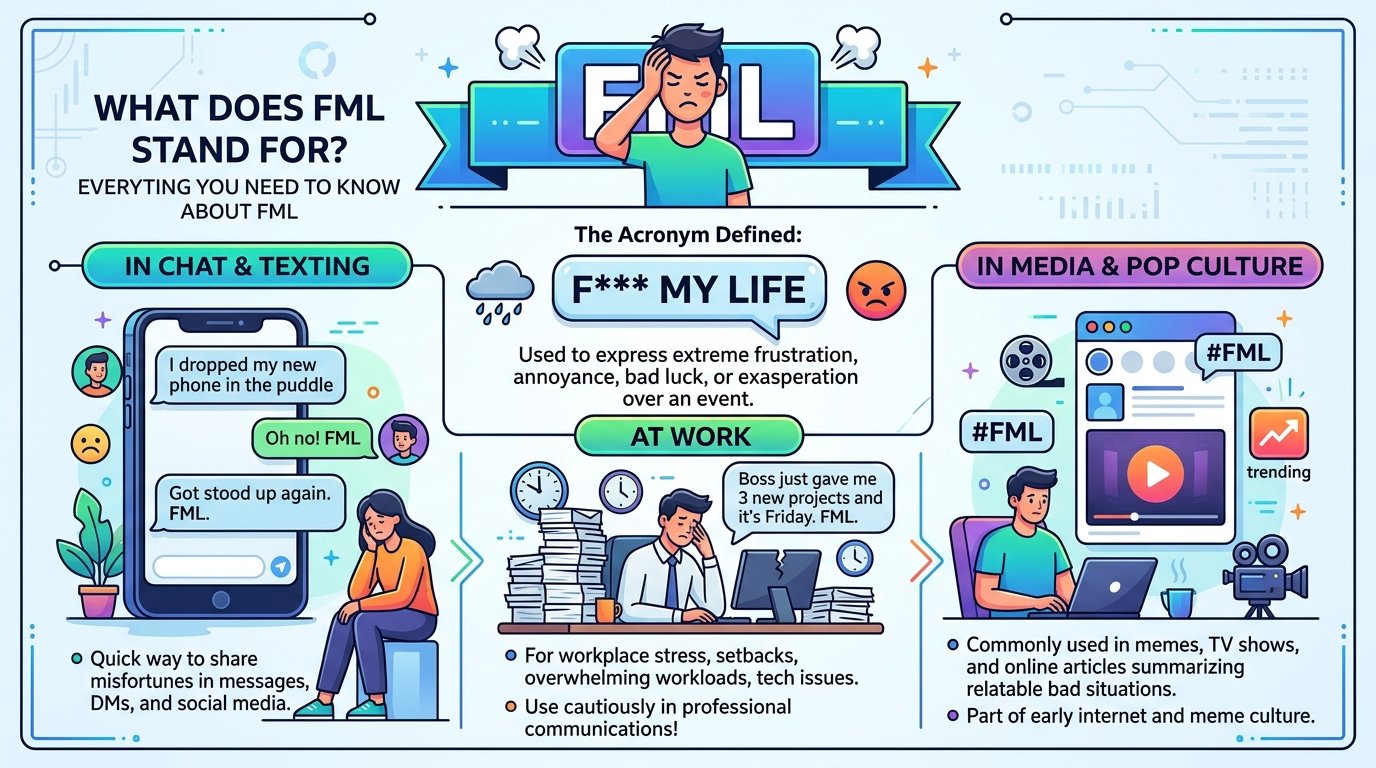
The most common meaning of FML is:
FML = “F* My Life”**
It is an internet slang expression used when someone experiences a frustrating, unlucky, or embarrassing event.
The phrase does not usually indicate a serious statement about someone’s entire life. Instead, people often use it humorously or dramatically to describe a bad moment.
Examples:
- “I spilled coffee on my laptop five minutes before my presentation. FML.”
- “I drove 30 minutes to the store and forgot my wallet. FML.”
- “My phone battery died right before I needed directions. FML.”
In these examples, FML communicates annoyance or disappointment rather than a literal statement.
FML Meaning in Simple Terms
| Context | Meaning | Example |
| Text messages | Frustration or bad luck | “Missed my flight. FML.” |
| Social media | Humorous complaint | “My dog ate my homework. FML.” |
| Online forums | Sharing an unfortunate experience | “Lost my files after a computer crash. FML.” |
| Workplace chat | Informal expression of stress | “The server went down again. FML.” |
The meaning is strongly connected to internet slang, where users often exaggerate emotions for humor or emphasis.
The History and Evolution of the FML Acronym
The rise of FML is closely connected to the growth of online communities and social media.
Internet abbreviations became popular in the late 1990s and early 2000s as instant messaging, forums, and texting became mainstream. Users wanted faster ways to communicate, leading to common abbreviations such as:
- LOL — Laugh Out Loud
- BRB — Be Right Back
- OMG — Oh My God
- TTYL — Talk To You Later
- FML — F*** My Life
The phrase became especially well known after the launch of the website FMyLife.com in 2008, a platform where users shared short stories about embarrassing or unlucky moments.
The site helped transform FML from casual slang into a recognizable internet expression. Similar storytelling formats later appeared across platforms such as Reddit, Twitter (now X), TikTok, and other social networks.
According to the Pew Research Center, social media usage has become a major part of modern communication, with approximately seven-in-ten Americans using social media platforms. As online interaction increased, internet-specific language and abbreviations became more common.
Why People Use FML in Digital Communication
People use FML because it quickly communicates an emotional reaction.
Instead of writing:
“I am extremely frustrated because something inconvenient happened.”
A person can simply write:
What does fml stand for
The acronym provides emotional context immediately.
Common Reasons People Use FML
1. Humor and Exaggeration
Many users use FML playfully rather than seriously.
Example:
“I woke up five minutes before my alarm. FML.”
The situation is inconvenient but not life-changing.
2. Sharing Relatable Experiences
FML is often used when people want others to relate to their experiences.
Examples include:
- Forgetting important items
- Making embarrassing mistakes
- Experiencing technical problems
- Missing deadlines
- Facing unexpected problems
3. Expressing Emotion Quickly
Digital conversations often happen in real time. Acronyms allow users to express feelings without writing long explanations.
Research on computer-mediated communication has shown that online language often develops shortcuts and informal expressions to replace some emotional cues normally available during face-to-face conversations.
FML in Chat and Text Messaging
In personal conversations, FML is usually understood as casual slang.
It commonly appears in:
- SMS messages
- WhatsApp conversations
- Discord chats
- Gaming communities
- Social media comments
- Group messages
Examples of FML in Chat
Friend: “How was your exam?”
Reply: “I studied all week, and the teacher canceled it. FML.”
Another example:
Message: “Just realized my meeting was yesterday, not today. FML.”
The expression adds emotion and personality to the message.
However, because the phrase contains profanity, users should consider their audience before using it.
Is FML Appropriate for Professional Communication?
The answer depends on the workplace environment and communication channel.
In professional settings, FML is generally considered informal. It may be acceptable among close colleagues in casual team chats, but it is usually inappropriate in formal communication.
Avoid Using FML In:
- Client emails
- Job applications
- Business proposals
- Official reports
- Executive presentations
- Customer support messages
Instead, use professional alternatives:
| Informal Expression | Professional Alternative |
| FML, the system crashed again | The system experienced another issue |
| FML, I missed the deadline | I apologize for missing the deadline |
| FML, this project is difficult | This project has several challenges |
Professional communication should prioritize clarity and respect, especially when messages represent a company or organization.
FML in Media and Popular Culture
Internet slang frequently moves from online communities into mainstream culture.
FML has appeared in:
- Television conversations
- Movies
- Comedy content
- Music discussions
- Online articles
- Memes
Its popularity reflects a broader trend: digital expressions often become part of everyday language.
Other internet terms that followed a similar path include:
- LOL
- Selfie
- Hashtag
- Meme
- Emoji
The Oxford English Dictionary and other language references have documented how internet communication continues to influence modern vocabulary.
Similar Acronyms and Related Internet Expressions
FML belongs to a larger category of emotional internet abbreviations.
Common Related Terms
| Acronym | Meaning | Usage |
| LOL | Laugh Out Loud | Humor |
| OMG | Oh My God | Surprise |
| SMH | Shaking My Head | Disapproval |
| WTF | What The F*** | Shock or confusion |
| IMO | In My Opinion | Sharing viewpoints |
| TBH | To Be Honest | Personal opinions |
Understanding these terms helps users navigate online conversations more effectively.
How FML Reflects Modern Online Language
Digital communication has created a balance between speed and emotional expression.
Traditional writing often requires complete sentences, but online communication frequently uses:
- Abbreviations
- Emojis
- Memes
- Reaction images
- Short phrases
These tools help people communicate tone and emotion quickly.
For example:
“I forgot my password again.”
This is a simple statement.
“I forgot my password again. FML 😭”
The second version communicates frustration and humor.
When You Should Avoid Using FML
Although widely understood, FML is not suitable everywhere.
Avoid using it when:
- Speaking with unfamiliar people
- Communicating professionally
- Writing academic content
- Posting publicly under your professional identity
- Communicating with children or younger audiences
The phrase contains profanity, and different audiences may interpret it differently.
A useful rule:
Use FML only when you are confident the audience understands and accepts informal language.
Frequently Asked Questions About FML
What does FML stand for?
FML usually stands for “F*** My Life.” It is an informal internet acronym used to express frustration, disappointment, or bad luck.
What does fml stand for in texting?
In texting, FML is a casual expression showing that someone is annoyed or experiencing an unfortunate situation. It is often used humorously.
Is FML a bad word?
FML includes profanity, so some people consider it inappropriate in formal situations. However, it is commonly used online as slang.
Can FML mean something different?
Yes. Acronyms can have multiple meanings depending on context. In internet conversations, however, the slang meaning is the most common.
Is FML acceptable at work?
Generally, FML should be avoided in formal workplace communication. Some informal team chats may allow it, depending on company culture.
Where did FML become popular?
FML became widely recognized through online communities and the website FMyLife.com, launched in 2008, where users shared humorous stories about unfortunate events.
Is FML the same as saying “my life is terrible”?
No. Most people use FML as an exaggeration. It usually describes a temporary problem rather than a serious belief about their life.
Why do people use internet acronyms like FML?
People use acronyms because they save time, communicate emotions quickly, and help create a shared online language.
Conclusion
FML is one of many internet acronyms that demonstrate how digital communication continues to evolve. While its meaning is informal and sometimes contains strong language, it has become a recognizable way for people to express frustration, humor, and relatable everyday struggles.
Understanding what does fml stands for helps users communicate more effectively across chats, social media platforms, and online communities. However, like any slang expression, its usefulness depends on context. Casual conversations may welcome it, while professional environments usually require more careful wording.
As online language continues to change, acronyms like FML show how people adapt communication to make digital conversations faster, more emotional, and more personal.