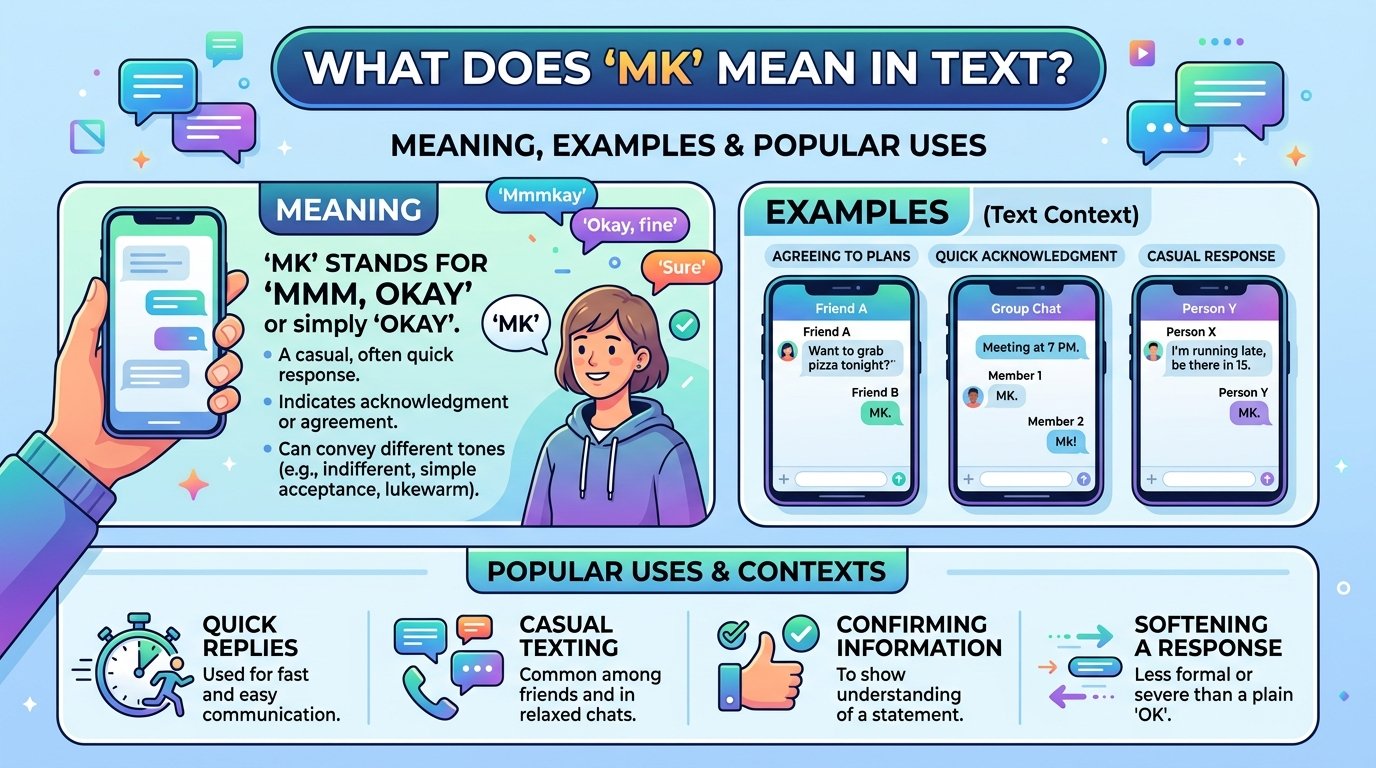
A simple two-letter reply can sometimes create more confusion than an entire conversation. If someone responds with “MK”, you might wonder whether they’re agreeing, being sarcastic, or simply ending the discussion. Because texting relies on short messages and limited context, abbreviations often carry different meanings depending on how they’re used.
If you’ve searched what does mk mean in text, you’re not alone. Internet slang changes quickly, and many abbreviations do not have just one definition. While “MK” usually means “okay” or “mm, okay,” its tone can shift based on the conversation, the platform, and even the relationship between the people texting.
People who want to understand MK usually want a clear answer, but the real meaning depends on context. This guide explains what MK means, where it came from, how people use it in everyday conversations, and how to recognize when it expresses agreement, hesitation, or mild annoyance. You’ll also find practical examples, platform-specific uses, common misconceptions, and answers to frequently asked questions.
What Does MK Mean in Text?
When people ask what does mk mean in text, the short answer is simple: MK is an informal abbreviation of “okay.”
Instead of typing the full word, many people shorten it to “MK” during casual conversations. The abbreviation is especially common in text messages, Snapchat, Instagram DMs, TikTok comments, Discord chats, and other messaging apps where speed matters.
Unlike many internet abbreviations that have multiple unrelated meanings, MK usually communicates some form of acknowledgment. However, the tone depends heavily on context.
For example:
- “MK, I’ll be there at 7.”
- “MK, sounds good.”
- “MK…”
- “MK then.”
Each sentence communicates something slightly different, even though the abbreviation remains the same.
In most situations, MK can express:
- Agreement
- Understanding
- Acceptance
- Mild reluctance
- Indifference
- A neutral response
Because written conversations don’t include facial expressions or voice tone, readers often interpret MK differently depending on punctuation and previous messages.
For anyone still wondering about MK, the surrounding conversation matters more than the abbreviation itself. A short reply can sound warm, neutral, or slightly cold depending on how it is used.
Where Did MK Come From?
MK did not begin as an official internet acronym. Instead, it developed naturally as people shortened common words while texting.
Many linguists believe the abbreviation comes from saying “mm, okay” in spoken conversation. When written quickly, “mm okay” eventually became “mk.”
This evolution is similar to other popular texting shortcuts like:
| Full Phrase | Short Form |
| Okay | OK |
| Thank you | TY |
| Be Right Back | BRB |
| I Don’t Know | IDK |
| Talk To You Later | TTYL |
As smartphones became more popular during the late 2000s, shortened responses became increasingly common because users wanted to type faster on smaller keyboards.
Today, MK appears across nearly every major messaging platform. Although younger users tend to use it more frequently, people of all ages recognize it as casual internet slang.
Pew Research Center has noted that texting and messaging are central to how teens communicate, and that trend has helped keep abbreviations like MK part of everyday online language. As digital conversations continue replacing phone calls, short replies remain a normal part of communication.
Most Common mk meaning
To understand the meaning in everyday conversation, it helps to look at the main ways people use it. Although MK usually means “okay,” there are several shades of meaning depending on the situation.
1. Agreement
The most common meaning is simple agreement.
Example
Person A: “Let’s meet after work.”
Person B: “MK.”
Here, the sender agrees with the plan.
2. Acknowledgment
Sometimes MK simply confirms that a message has been read and understood.
Example
“I’ll send the files tonight.”
“MK.”
No excitement or disagreement is implied.
3. Reluctant Acceptance
Occasionally, MK suggests someone isn’t completely happy but accepts the situation anyway.
Example
“I can’t come this weekend.”
“MK.”
Depending on the relationship, this response may sound slightly disappointed.
4. Ending a Conversation
Some people use MK to close a discussion politely without continuing it.
Example
“Thanks for letting me know.”
“MK.”
The conversation naturally ends after that.
In almost every case, context determines whether MK sounds friendly, neutral, or slightly cold. That is why the meaning cannot always be answered with just one fixed definition.
How Context Changes the mk meaning
The meaning of MK changes depending on the tone of the conversation, the punctuation used, and the relationship between the people texting. A short reply can feel supportive in one chat and dismissive in another.
Consider these examples:
- Friendly: “MK, see you soon.”
- Neutral: “MK.”
- Slightly annoyed: “MK…”
- Dismissive: “MK then.”
The same abbreviation can communicate very different emotions.
Here are a few things that affect interpretation:
- Punctuation: A period or ellipsis can make MK sound colder.
- Timing: A fast reply may feel casual, while a delayed reply may seem less enthusiastic.
- Relationship: Friends often read MK differently than coworkers or family members.
- Conversation history: Earlier messages usually reveal whether MK is supportive, rushed, or irritated.
If you’re unsure, the safest approach is to read the full conversation before deciding what the sender intended.
MK on Popular Social Media Platforms
The meaning of MK stays fairly consistent across most social media apps, but the tone can change depending on how people communicate on each platform. Understanding the environment helps you interpret the message correctly.
Snapchat
Snapchat is designed for quick, casual conversations. Here, MK is usually a short way of saying “okay” or “I understand.”
Example:
Alex: “I’ll send you the Snap later.”
Jordan: “MK 👍”
In this conversation, the reply simply acknowledges the message without adding anything else.
TikTok
On TikTok, MK often appears in comments and direct messages. Users typically use it to agree with another comment or react casually to a creator’s content.
Example:
“MK, that’s actually a great idea.”
Since TikTok conversations are informal, abbreviations like MK fit naturally into discussions.
Instagram users commonly use MK in direct messages rather than public captions. Friends may reply with MK when making plans, confirming information, or acknowledging a message.
Example:
“We’re meeting at 6.”
“MK, see you then.”
Discord
Discord communities, especially gaming servers, move quickly. Members often use short replies like MK because they’re chatting in real time while playing games or discussing projects.
Example:
“Raid starts in 10 minutes.”
“MK, joining now.”
Facebook Messenger and WhatsApp
On messaging platforms like Facebook Messenger and WhatsApp, MK carries the same meaning. It usually indicates that someone has read the message and agrees or understands what was said.
Real-World Examples of MK in Conversations
Looking at realistic conversations makes it much easier to understand how people actually use MK in daily communication.
Example 1: Agreeing With Plans
Emma: “Let’s grab coffee after work.”
Ryan: “MK, see you then.”
Here, MK simply means “okay.”
Example 2: Confirming Instructions
Manager: “Please email me the report before noon.”
Employee: “MK.”
This shows that the employee understands the request.
Example 3: Slight Disappointment
Friend: “I can’t make it tonight.”
You: “MK.”
The reply could suggest disappointment depending on the previous conversation and relationship.
Example 4: Family Chat
Mom: “Dinner is ready.”
Teen: “MK.”
Many parents have probably seen this exact reply. It’s brief but usually means, “I got your message.”
Example 5: Group Chat
Friend: “Movie starts at 8.”
Everyone: “MK.”
Short acknowledgments keep the conversation moving without unnecessary messages.
These examples show that tone matters just as much as the abbreviation itself. The full exchange usually gives the clearest answer.
Common Mistakes and Misconceptions
Because MK is so short, it’s easy to misunderstand. Here are some of the most common mistakes people make.
Assuming It Always Sounds Rude
Many people think MK is passive-aggressive. In reality, it’s often just a faster way to type “okay.” Whether it sounds rude depends on punctuation, context, and the relationship between the people chatting.
Ignoring Context
Reading only one message can lead to incorrect assumptions. Looking at the entire conversation usually makes the meaning obvious.
Confusing MK With Other Abbreviations
Some users mistake MK for unrelated internet slang or initials. In everyday texting, it almost always represents a variation of “okay.”
Overthinking the Reply
Not every short response has a hidden meaning. Sometimes people simply want to reply quickly.
Forgetting Different Generations Text Differently
Teenagers, adults, coworkers, and family members often use abbreviations differently. A younger user may type MK frequently, while an older person might prefer writing the full word “okay.”
If you ever wonder about MK, remember that the answer is usually simpler than it first appears.
MK vs. OK vs. K
Although these responses seem similar, they don’t always communicate the same tone.
| Response | Meaning | Typical Tone | Best Used When |
| MK | Okay / Mm, okay | Casual, neutral | Friends, family, informal chats |
| OK | Okay | Neutral and clear | Personal and professional conversations |
| K | Okay | Can sound short or abrupt | Very casual texting, close friends |
In professional communication, writing “OK” or “Okay” is usually a better choice because it’s clearer and less likely to be misunderstood.
When Should You Use MK?
MK works best in informal conversations where everyone understands casual texting language.
Good situations include:
- Chatting with friends
- Replying in family group chats
- Casual social media messages
- Making simple plans
- Confirming information
Avoid using MK in:
- Job applications
- Business emails
- Academic writing
- Professional reports
- Formal customer communication
Choosing the right response for the situation helps prevent misunderstandings and creates a more professional impression when necessary.
Frequently Asked Questions
1. What does mk meaning in text?
MK usually means “okay” or “mm, okay.” People use it to acknowledge a message, agree with someone, or confirm that they understand what was said.
2. Is MK rude in texting?
Not usually. Most of the time, MK is simply a casual response. However, depending on the conversation and punctuation, it can sometimes sound uninterested or slightly annoyed.
3. What does MK meaning on Snapchat?
On Snapchat, MK generally means “okay.” Friends often use it as a quick acknowledgment before ending a conversation or confirming plans.
4. Is MK the same as K?
No. While both can mean “okay,” MK usually sounds friendlier and less abrupt than replying with a single “K,” which some people interpret as cold or dismissive.
5. Can MK have other meanings?
Outside of everyday texting, MK may represent company names, initials, video game titles, or abbreviations in specific industries. In casual messaging, however, it almost always means “okay.”
6. Should I reply with MK?
Yes, if you’re having an informal conversation with friends or family. For professional communication, it’s better to type “OK” or “Okay” to avoid confusion.
Conclusion
mk meaning is one of the simplest abbreviations used in digital communication, yet its tone depends on context. In most conversations, it means “okay” or “mm, okay” and serves as a quick way to acknowledge a message, agree with someone, or confirm understanding. Whether you’re chatting on Snapchat, Instagram, TikTok, Discord, WhatsApp, or regular text messages, the surrounding conversation is the best guide to interpreting its meaning. So if you ever ask what does mk mean in text, remember that the answer is usually found in the context, not just the letters themselves.