You’re in a group chat, someone drops “ONB,” and the whole conversation keeps moving like nothinas ifppened. If you had to pause and ask what that meant, you’re not alone. A lot of people run into that exact moment when texting with friends, scrolling comments, or watching short-form videos. If you searched for onb meaning slang, you probably want a straight answer, not a vague internet explanation.
ONB is one of those short expressions that look confusing at first but become easy once you see it in context. People use it to sound serious, honest, or confident about what they’re saying. It shows up in casual messages, gaming chats, social media replies, and sometimes in music-related conversations too. The tricky part is that slang like this can have more than one interpretation depending on the community using it.
This guide breaks down what ONB means, where it came from, how people actually use it, and when it makes sense to use it yourself. You’ll also see how it compares with similar slang terms, plus examples that make the meaning much clearer. By the end, you’ll know exactly how to read it and how to use it naturally without sounding forced.
What Is ONB?
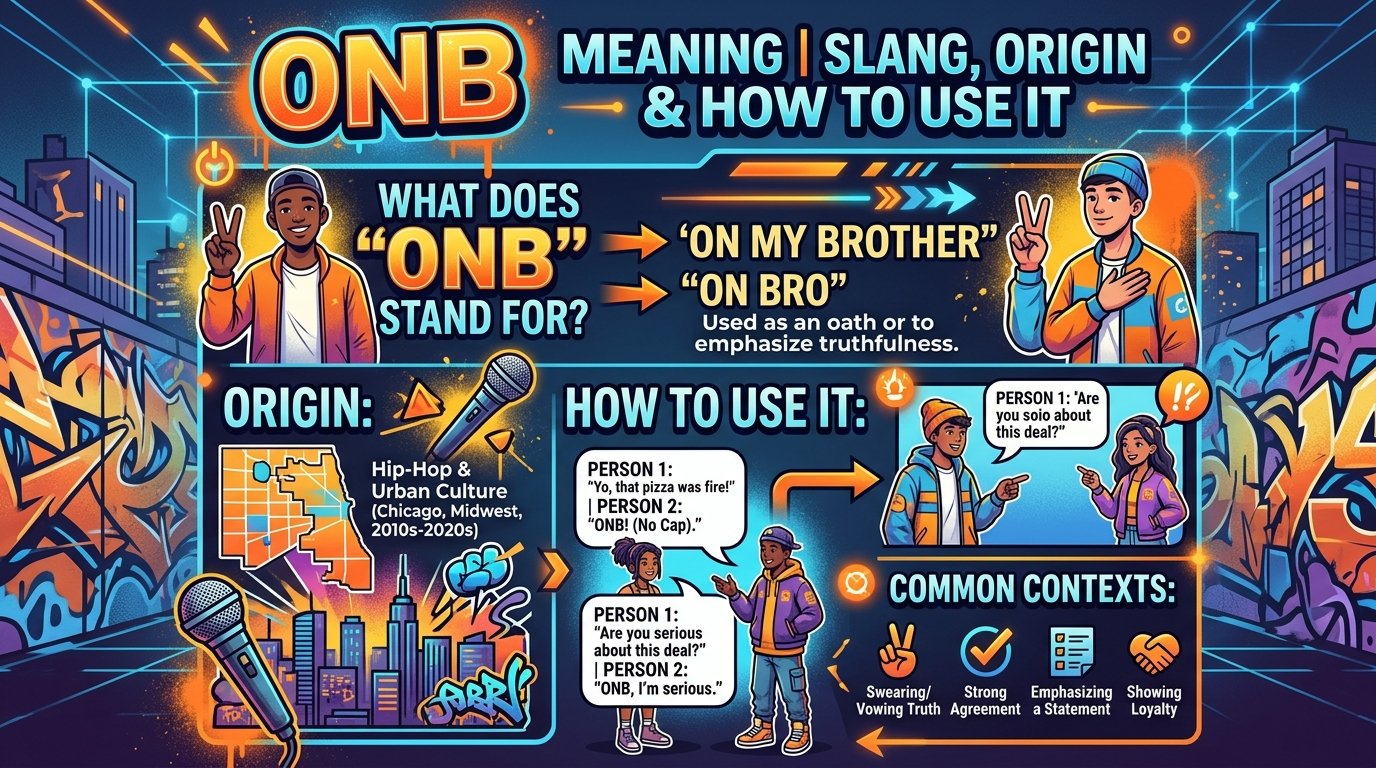
The phrase onb meaning slang refers to the abbreviation ONB, which most commonly stands for “On Bro” or “On Bronem.” It’s used as a way to stress honesty, seriousness, or strong belief in what someone is saying. In plain English, it works a lot like saying “I swear,” “for real,” or “I mean it.”
For example:
- “ONB, I didn’t take your charger.”
- “That place has the best fries, ONB.”
- “ONB, you need to watch that show.”
The meaning is simple, but the tone matters. ONB is not usually used in formal writing or professional settings. It belongs to casual speech, especially among people who already know the style of internet slang. In many cases, it adds emphasis without making the sentence longer.
There’s also a cultural side to it. In some communities, especially in Chicago slang, “On Bronem” has a deeper meaning tied to loyalty and trust. Over time, though, many people online started using it more loosely as a general expression of truthfulness. That’s why you’ll see it in texts, captions, comments, and even memes.
So if someone says ONB, they’re usually trying to convince you they’re being real, not joking, and not exaggerating.
The Origin of the ONB meaning Slang
ONB didn’t start as a TikTok trend. Like many slang terms, it began in spoken language long before it became a typed abbreviation. Its roots are commonly linked to Chicago street slang, where phrases like “On Bro” and “On Bronem” were used as verbal oaths. The idea was simple: instead of just saying “trust me,” the speaker would swear on a brother, close friend, or someone important to show sincerity.
Rap music helped spread the phrase beyond its original community. As Chicago artists gained attention, listeners from other cities started hearing the expression in lyrics, interviews, and social clips. Once social media got involved, the term moved even faster. People shortened it to ONB because typing three letters is easier than writing out the full phrase every time.
Platforms like TikTok, Snapchat, Instagram, X, and Discord helped turn spoken slang into everyday internet language. That’s why a phrase that once belonged to a specific region now appears in conversations across the country and beyond. Even people who don’t know the full background still use it because it sounds natural in casual online talk.
How People Use ONB in Everyday Conversations
The easiest way to understand onb meaning slang is to see how it fits into real conversations. ONB usually appears when someone wants to sound believable, serious, or strongly supportive of what they’re saying. It can go at the beginning or end of a sentence, depending on the speaker’s style.
1. To prove honesty
- “ONB, I already sent the file.”
- “I didn’t touch your stuff, ONB.”
2. To recommend something
- “That burger spot is amazing, ONB.”
- “ONB, you should try that show.”
3. To show confidence
- “ONB, this plan will work.”
- “That player is the best on the team, ONB.”
4. To react casually
- “ONB, that was wild.”
- “ONB yes, that song is fire.”
5. In gaming or group chats
- “ONB, that weapon is broken.”
- “ONB we need one more player.”
The tone is usually relaxed, not dramatic. People use it when they want to sound real without writing a long explanation. It works best in conversations where everyone already understands the style. If you use it with friends, it can sound natural. If you use it with someone who doesn’t know slang well, it may confuse them.
That’s why context matters. ONB is less about the words themselves and more about the confidence behind them.
ONB vs Similar Slang Terms
Internet slang has a lot of expressions that overlap, so it helps to know how ONB compares with similar phrases. Some terms mean almost the same thing, while others carry a slightly different tone.
| Slang | Meaning | Typical Use |
| ONB | On Bro / On Bronem | Emphasizing honesty or seriousness |
| No Cap | No lie | Saying something is true or not exaggerated |
| FR | For real | Agreeing or confirming sincerity |
| ONG | On God | Strong oath or serious promise |
| ISTG | I Swear To God | Expressing seriousness, frustration, or emphasis |
| NGL | Not Gonna Lie | Giving an honest opinion |
Here’s the difference in plain language:
- No Cap is often used when someone wants to say they’re not exaggerating.
- FR is more flexible and can mean “seriously” or “I agree.”
- ONG feels stronger because it uses a religious oath.
- ISTG can sound more emotional or frustrated.
- NGL is usually used before an honest opinion.
ONB sits in a comfortable middle ground. It’s strong enough to show sincerity but casual enough to fit everyday texting. That balance is one reason it became so popular. It doesn’t sound too formal, and it doesn’t sound too intense either.
When You Should and Shouldn’t Use ONB
Knowing the meaning is one thing. Knowing when to use it is another. ONB works best in casual spaces where slang is normal, and the people involved understand the tone.
Good situations
- Texting close friends
- Commenting on social media
- Talking in gaming chats
- Sending casual group messages
- Reacting in informal conversations
Situations to avoid
- Job applications
- Professional emails
- School essays
- Business meetings
- Formal presentations
If you’re talking to someone older, more formal, or unfamiliar with internet slang, ONB may sound strange or out of place. In those cases, plain language is better. You can say:
- I promise.
- I’m serious.
- Honestly.
- I swear.
- That’s true.
The main rule is simple: match your language to the setting. Slang works when it feels natural. If you force it into the wrong situation, it can sound awkward or even disrespectful. That’s why understanding the audience matters just as much as understanding the phrase itself.
Real-World Examples of ONB
Seeing ONB in full conversations makes the meaning much easier to understand. Here are a few realistic examples from everyday life.
Example 1: Food recommendation
Friend: “Is that taco place actually good?”
Reply: “ONB, it’s one of the best spots in town.”
Example 2: Homework
Friend: “Did you finish the assignment?”
Reply: “ONB, I turned it in last night.”
Example 3: Sports
Friend: “Was the game worth watching?”
Reply: “ONB, it was one of the best matches this season.”
Example 4: Gaming
Player 1: “That strategy won’t work.”
Player 2: “ONB it works e, very time if you do it right.”
Example 5: Music
“ONB, that album has no skips.”
Example 6: Travel
“I’ve been there twice. ONB, the beach is worth the trip.”
Example 7: Social media comment
“ONB, this is the funniest video I’ve seen today.”
In each case, the phrase doesn’t change the actual meaning of the sentence. It just adds emphasis. The speaker wants the listener to know they’re being real, not joking, and not stretching the truth.
Common Mistakes and Misconceptions
A lot of confusion around onb meaningtheang comes from the fact that people assume every abbreviation has one fixed meaning. That’s not always true. Slang changes depending on region, age group, and online community.
Mistake 1: Thinking it only means one thing
Most people use ONB to mean “On Bro,” but some communities connect it to “On Bronem.” The meaning is close, but the background can shift depending on who’s speaking.
Mistake 2: Using it in formal writing
ONB is casual slang. It doesn’t belong in reports, essays, business emails, or professional messages.
Mistake 3: Overusing it
If you put ONB in every sentence, it loses impact. Like any emphasis word, it works best when used sparingly.
Mistake 4: Assuming everyone knows it
Not everyone follows internet slang closely. Some people may need context or may not recognize the abbreviation at all.
Mistake 5: Ignoring the cultural background
Many slang terms come from specific communities before they spread online. It’s better to understand that history instead of treating the phrase like random internet noise.
The safest approach is to use ONB naturally, in the right setting, and with people who understand casual slang.
Why ONB Became So Popular
Part of why onb meaning slang spread so fast is that it fits the way people already talk online. It’s short, easy to type, and useful in a lot of different situations. That makes it perfect for texting and social media, where speed matters.
Several things helped push it into wider use:
- Fast texting habits
- TikTok videos and captions
- Rap and hip-hop influence
- Meme culture
- Snapchat and Instagram comments
- Gaming communities
- Group chat conversations
Another reason it caught on is that it sounds confident without being too heavy. People like slang that adds personality to a message without making it feel stiff. ONB does that well. It can sound serious, playful, or supportive depending on the sentence around it.
It also helps that the phrase is flexible. You can use it before a statement, after a statement, or even as a quick reply. That makes it easy to fit into different kinds of conversations, from sports and music to food, travel, and relationships.
Like many slang terms, it may fade or change over time. But for now, it remains a recognizable part of online speech.
Frequently Asked Questions
What does onb meaning slang mean in texting?
ONB usually means “On Bro” or “On Bronem.” In texting, people use it to show they’re being honest, serious, or confident about what they’re saying. It works like a casual oath or a stronger version of “I swear.”
Is ONB the same as “No Cap”?
Not exactly. “No Cap” means no lie or no exaggeration, while ONB feels more like a personal promise or statement of truth. They overlap a lot, but ONB often sounds a little more direct and oath-like.
Where did ONB come from?
ONB is commonly linked to Chicago slang. It grew from phrases like “On Bro” and “On Bronem,” which were used to show sincerity. Later, rap music and social media helped spread it to a much wider audience.
Can I use ONB at work or school?
Usually not. ONB is informal slang, so it doesn’t fit well in professional emails, school essays, or formal presentations. In those settings, it’s better to use clear language like “I promise” or “I’m serious.”
Is ONB still popular on TikTok?
Yes, it still appears in captions, comments, and short videos. TikTok has helped keep many slang terms alive because users repeat them quickly and often. ONB remains common in casual online conversations.
Does everyone use ONB the same way?
No. Some people use it as a serious statement, while others use it jokingly or casually. The meaning stays close, but the tone can change depending on the group, region, or platform.
Conclusion
Learning online slang makes online conversations much easier to follow. Once you know that ONB usually means “On Bro” or “On Bronem,” the abbreviation stops looking mysterious and starts making sense in context. It’s a casual way to show honesty, confidence, or seriousness, and it shows up often in texts, comments, gaming chats, and social media posts. The key is using it in the right setting. It works well with friends and online communities, but it doesn’t belong in formal writing or professional communication. If you understand the meaning, origin, and tone, you’ll recognize it instantly and use it naturally when the moment calls for it.